
Diagnosis
Navigating neurodivergence, diagnosis, and self-acceptance in the age of AI

AuDHD? Me?
After hitting burnout in late 2024, a psychologist suggested I might be autistic and have ADHD (AuDHD). I was surprised and a little confused. But when I learned about what AuDHD looks like in women, reading their stories, I was relieved to see my life story mirrored in theirs. I felt seen and held.
I now strongly suspect I am AuDHD. Yet, I still go back and forth on this self-diagnosis daily. The barriers to a formal diagnosis - gatekeeping professionals who say, “But you run a business and have a partner, you must be fine”; concerns of cultural mismatches in the Netherlands or gender bias causing a false negative; and the sheer cost alongside a wedding and starting a business led me to put formal diagnosis on the shelf.
Diminished Self-Trust
Yesterday, I attended a talk by Rosie Turner, founder of ADHD Untangled, that deeply spoke to me.
As Rosie discussed the self-trust challenges facing ADHDers, I felt a profound pain and sadness in my heart.
While I had put formal diagnosis on the shelf for over a year, not knowing for sure lingers in the form of self-doubt. This affects not only my life as a business owner, but my ability to navigate technology in the intentional way I strive to support my clients to do.
Neurotype and Technology
As a coach and AI ethicist, I’ve supported clients who are neurodivergent and seen the impact knowledge and self-understanding can have. People who are neurodivergent have different needs and concerns when it comes to technology and AI use, and understanding that can help them use them in empowering ways. For example:
For ADHD: Using AI to generate meeting summaries, using voice-to-text to overcome “writer’s block,” persistent smartphone reminders to jog memory
For Autism: Drafting emails to navigate social uncertainties, creating and supporting structured routines
But I’ve also seen it backfire spectacularly, becoming engines of burnout.
The Notification Loop: The constant connectivity of our digital lives, constant “pings,” all leading to overstimulation
The Homogenization Trap: AI is trained on “average” (neurotypical) data and mimics that voice. They can write emails stripped away of authentic voices, deriving us of diverse ways of communicating.
Weird

AI is WEIRD - trained to emulate Western, Educated, Rich, and Democratic values. And that's a problem.
Navigating Accessibility and Conformity
AI and technology, in its current form, acts as a homogenizing force. It encourages us all to speak the same “professional” language and constantly be “on” with floods of notifications. For a neurodivergent person, this can be incredibly draining and erases the gifts our way of thinking and communicating can give to the world.
This also can contribute to burnout - and it certainly did to mine. Reflecting on living life at a slower, more intentional pace, and changing my relationship with technology, was the catalyst for founding my coaching business, Purposely Digital, and this partner Substack about a year ago now.
This brings me to the crux of this article, the core ethical concern: How can we use technology to increase accessibility and accommodate our needs, while resisting the pressure on us to conform?
How can we use technology to increase accessibility and accommodate our needs, while resisting the pressure on us to conform?
I don’t know if I have a blanket, generalizable answer. I could make some ethical arguments around what could be done on the design side - how we design AI and technology, who is in the room, what voices are heard, what we could do better.
While design is important, what I have seen first-hand is the power of coaching - to slow down, reflect, dig deep into values - at holding space for my neurodivergent clients to figure out how to navigate this tension. And I’m skeptical that design can capture all our needs (although it can of course be more inclusive), as all our access needs, and our life stories and situations, are incredibly unique.
I’m not sure yet if I will seek that formal diagnosis. If you wish, I would love to hear your own diagnosis journey (self- or formal-) in the comments as I navigate this myself. As many of you know, it can be disorienting and lonely journey.
But I do know this - Rosie’s call yesterday to self-trust is a wake-up call for some self-coaching. That pain of doubting my own needs is all too real.
The Heron’s Perch
Coaching questions to ponder

How does your neurotype impact your relationship with AI and technology?
How might you honor your unique needs through how you digitally engage?
An Offering
Are you interested in working with me to engage intentionally, consciously, and ethically with the technology in your life?
As a thank-you as we approach the 1-year anniversary of Purposely Digital (the coaching business and the Substack), I’d love to offer subscribers 30% off my core coaching program, “Learning to Fly.” You are also welcome to offer this to a friend or family member who might benefit, if you so choose.
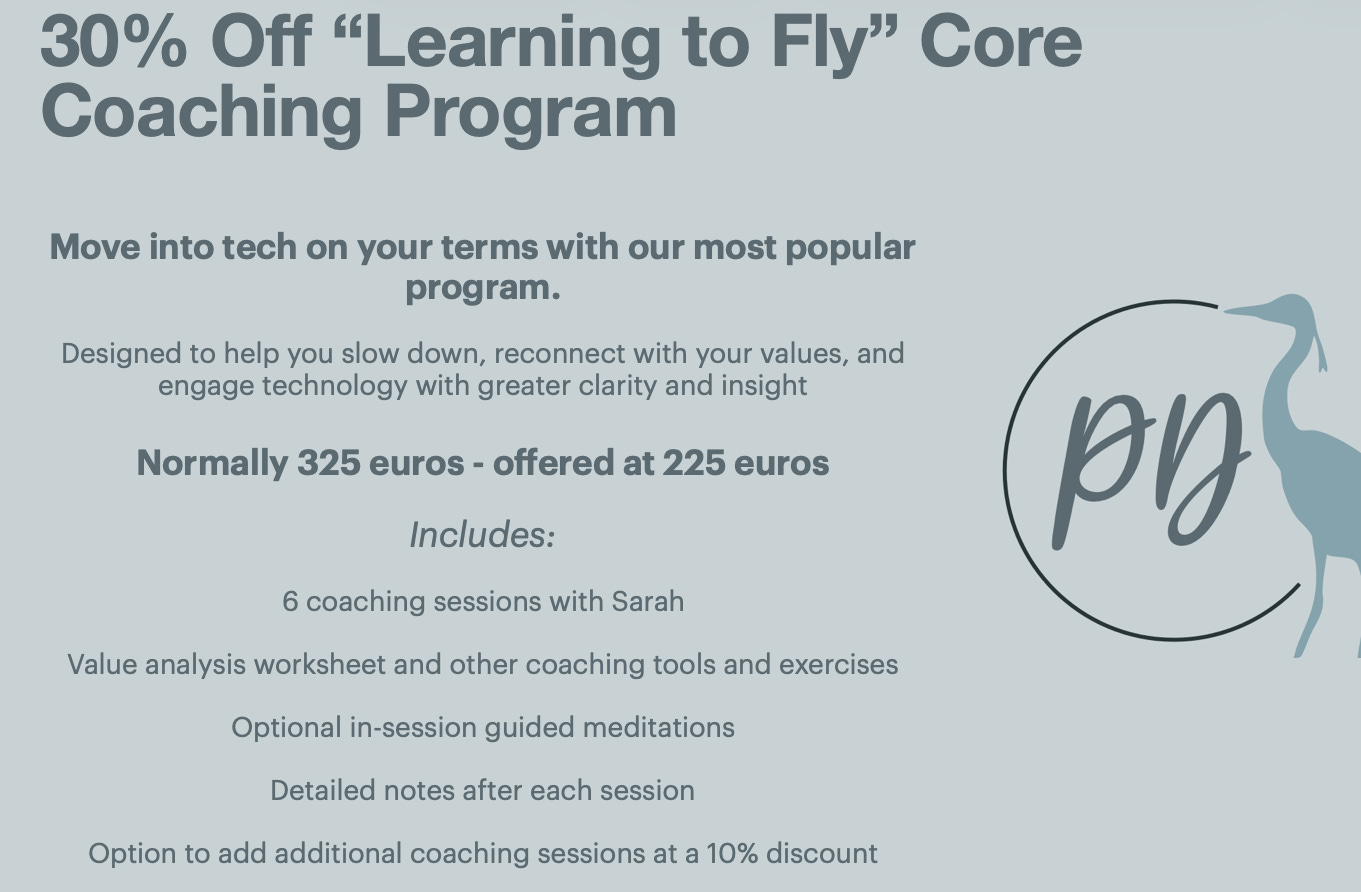
To learn more, you can reach out to me directly at sarah@purposely-digital.com or learn more at https://purposely-digital.com.
Thank you for being here. I’m so profoundly grateful.